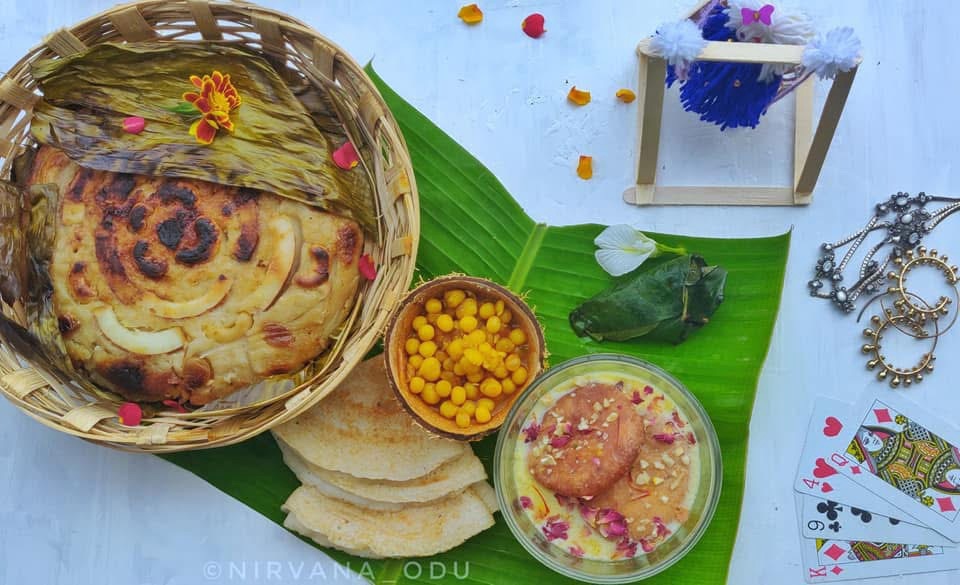
Ah, you see quite a lot of other things here, but today, I’m going to share about Podo Pitha.
Raja Parba is incomplete without it! This traditional Odia delicacy is a labor of love and patience. I feel it’s one of the most challenging recipes to master, but once you get it right, it’s a cakewalk every time after that.
Podo Pitha is customized across Odisha—some use sugar, others jaggery, and many add dry fruits and grated coconut for that extra richness. Recently, I’ve even seen people making it like a proper cake with frosting, and while the modern twist is fascinating, the love for the authentic Podo Pitha remains unshaken.
It’s the essence of tradition, nostalgia, and flavor, wrapped in one humble dish!
I remember how my hands used to start aching while mixing the rice and jaggery batter for Podo Pitha. It was such a task! My mom would always step in and take over, her hands moving with effortless ease, while I watched in awe.
Back then, I never dared to try making it on my own—it felt too daunting. But now, even my husband helps me out in the mixing as he used to do the same for his mother, and it’s a wonderful feeling to finally get it right. The effort feels worth it every single time!
Pitha Panna was always a team effort. I vividly remember how every family member would come together to help—one preparing the batter, another wrapping it, and someone else frying. It was such a beautiful symphony of togetherness!
The excitement would double when I’d return from school and see all the neighborhood aunties gathered, laughing, chatting, and working in perfect harmony. My Ayi (grandmother) would often say, “This is the beauty of a joint family and having loving people around you.” She never held grudges or indulged in fights; her warmth and positivity were unmatched.
But now, times have changed. People seem to carry more hatred and trust issues, and while I agree it works both ways, I can’t help but miss those golden days of pure connection and love.
Anyway, I won’t deviate further—here’s the recipe!
Ingredients
• 1 cup rice
• 1/2 cup split or whole husked urad dal
• 1 cup jaggery
• 3/4 cup grated coconut
• 1-inch ginger, finely chopped and pounded
• 1 tsp crushed green cardamom pods and black peppercorns
• 1/4 tsp roughly crushed fennel seeds
• 5-6 bay leaves
• 4 tbsp ghee (or oil, though ghee enhances the flavor)
• 1 tsp salt
• 1 tsp baking powder
• 1 tbsp brown sugar or jaggery powder for dusting the pan
• 1/4 cup thinly sliced coconut
• 1/2 cup cashews and raisins
• 1-2 banana or sal leaves (optional, to wrap the batter)
Method (Kadai Version)
1. Soaking and Fermentation
• Soak rice and urad dal for 5-6 hours or overnight.
• Wash and drain the water, then grind into a coarse paste using as little water as possible.
• Leave the batter to ferment for 3-4 hours. If you’re in a hot climate, 1-2 hours will suffice.
2. Preparing the Garnish
• Heat 1 tsp ghee in a pan and roast cashews and raisins until the raisins puff up. Keep aside.
3. Prepping the Kadai
• Take a heavy-bottomed kadai with a tight-fitting lid. Place a stand or a thick layer of salt at the bottom to create an even heat source.
• Cover with the lid and preheat on medium flame for 10 minutes.
4. Greasing the Pan
• Grease a cake tin or any deep vessel that fits inside the kadai with ghee.
• Dust it with brown sugar or jaggery powder. Tear 4 bay leaves and line the base of the pan.
• If using banana or sal leaves, line the tin with the leaves first.
5. Mixing the Batter
• In a large bowl, mix the fermented batter with jaggery, grated coconut, half the sliced coconuts, remaining ghee, cardamom, pepper, fennel, remaining bay leaves (torn into bits), salt, baking powder, and half of the roasted cashews and raisins.
6. Assembling and Cooking
• Pour the batter into the prepared tin and decorate the top with the remaining cashews, raisins, and sliced coconut.
• Place the tin on the stand inside the preheated kadai. If you have an oven, you can bake it as per the instructions.
• Cover with the lid and cook on low flame for 50-60 minutes. Check periodically after 40 minutes.
7. Checking Doneness
• Insert a toothpick or knife to check if it’s done-it should come out clean. If not, cook for another 5-10 minutes.
8. Cooling and Serving
• Let the Pitha cool completely before slicing.
Tip-The slow cooking in a kadai gives the Pitha an authentic smoky flavor, similar to the traditional method. Adjust the flame to ensure even cooking without burning the base.
During those days, rice would take a backseat because Pitha would reign supreme! It was a tradition to prepare various types of Pitha in large quantities, enough to last for days.
Stored carefully, they could be savored at any time—be it breakfast, lunch, or even as an evening snack. The best part? Each bite carried the essence of family love and togetherness, making every meal special, no matter the time of day.
 Nirvana Odu
Leave a comment